


 Train routes operated by SNCB
16 routes · classic 15 · scenic 1
SNCB runs 16 of the routes in the World Train Map atlas, 1,647 km of railway across 2 countries. The longest is the Intercity at 261 km; the fastest is the Intercity Dendermonde–Kortrijk, running up to 160 km/h; the oldest line it runs over here opened in 1836. 1 of its routes crosses an international border.
The company itself dates to 1926, filed on Wikidata as a national railway. What this page says about the company comes from SNCB's own Wikidata item, checked against the countries its routes here actually cross before any of it is used; everything about the railway is counted from this atlas. Official site ↗ · Wikipedia ↗ · Wikidata Q524255 ↗
Open the world railway map →Classic (15)
- Intercity
From the coast to the German-speaking east in one train: Ostend, Bruges and Ghent, the three Brussels stations, Leuven and Liège, then up the Vesdre valley by Verviers to Eupen.
- Intercity
The long way to the sea: from the airport out to Denderleeuw, then Oudenaarde, Kortrijk and Roeselare through the Flemish Ardennes before Bruges and Ostend.
- Intercity
From Poperinge’s hop fields through Ypres, then along the French border by Wervik and Menen to Kortrijk, Ghent and Antwerp; the last link, the rail tunnel under the Scheldt, opened in 1970.
- Intercity Dendermonde–Kortrijk
Flanders corner to corner through the middle of Brussels, Dendermonde to Kortrijk and the French border beyond, on the Halle to Tournai line the young Belgian state opened in 1842.
- Intercity
One of Belgium’s original 1838 trunk lines, running dead-flat across Flanders through Ghent and Bruges to the North Sea ferry port of Ostend.
- Intercity
Down the oldest railway on the Continent, Brussels to Mechelen in 1835, then the 1843 line south past Nivelles into the Sambre coalfield at Charleroi.
- Intercity
Terminates beneath Santiago Calatrava’s soaring white vault of steel and glass at Liège-Guillemins, one of Europe’s boldest modern stations.
Wikipedia (NL) ↗ - Intercity
East across the Campine heath from Antwerp, through Lier, Herentals, Geel and Mol to Hamont in the far corner of Limburg, on rails completed in 1879.
- Intercity
West Flanders end to end: out of the dunes at De Panne past Veurne and Diksmuide, then Tielt and Deinze to Ghent, on the line that finally reached the coast in 1870.
- S41
From Verviers down the Vesdre valley to Liège, north by Herstal and Liers, then over the curve at Glons, laid in 1973 to join the line the German army built in 1917, for Tongeren and Hasselt.
Wikipedia (NL) ↗ - Intercity
The Louvain-to-Charleroi company opened its whole route in 1855, Leuven to Wavre in February and the last stretch into the Sambre coalfield that August; the IC-24 still runs it end to end.
- Intercity
Flanders’ two great cities in an hour, straight through the Waasland at Sint-Niklaas and Lokeren, on a line that reached Ghent in 1847 but Antwerp’s own stations only in 1970, through the Kennedy tunnel under the Scheldt.
- Intercity
Forty-six minutes down the Meuse, Liège to Namur under the cliffs and citadels of the valley, on the line the Namur to Liège company opened along the riverbank in 1850.
- Intercity
Traces the route of continental Europe’s first passenger railway of 1835 and ends under the vast domed railway cathedral of Antwerpen-Centraal.
Wikipedia (NL) ↗ - Maubeuge–Charleroi railway
Charleroi to the French frontier at Erquelinnes opened on 6 November 1852, and the Nord company’s line from Saint-Quentin met it there on 11 August 1855, on the old main road from Paris to Brussels.
Wikipedia ↗
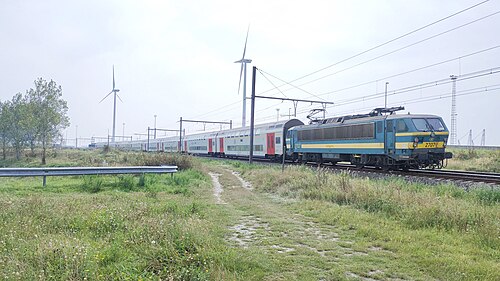
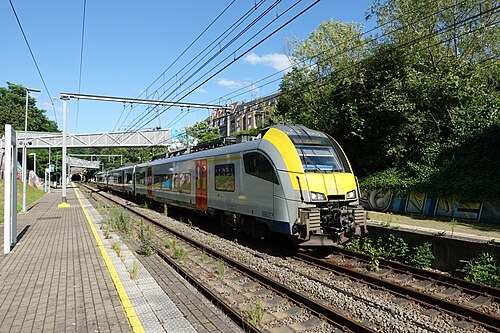
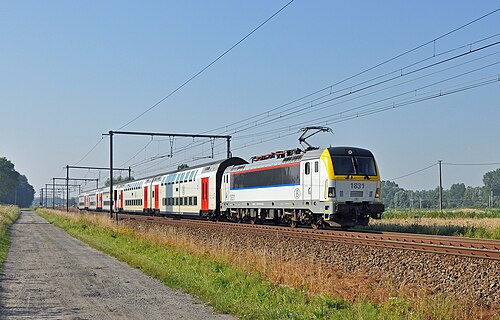
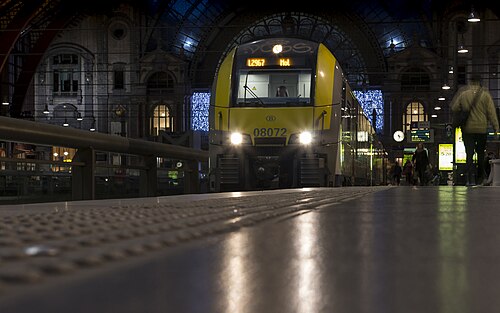
Scenic (1)
- Line 166 (Athus–Meuse)
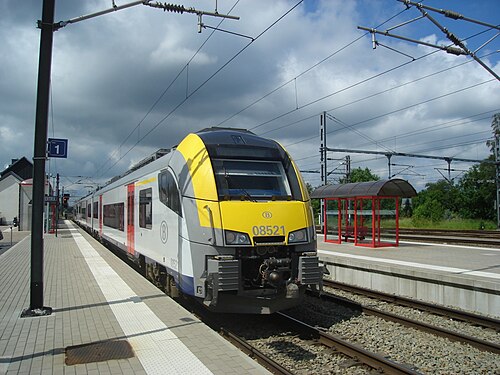
Up the Meuse and over the Ardennes from Dinant to Bertrix: passenger trains on the Athus–Meuse freight road between Antwerp and Basel.
Wikipedia (FR) ↗
Photos via Wikimedia Commons; each route page credits the author & licence
How many train routes does SNCB run?
16 of the routes in this atlas are SNCB services, covering 1,647 km across 2 countries (Belgium, France). That is what this atlas draws, not the operator's whole network: a national railway runs thousands of local services no map of notable journeys would list.
What is the fastest SNCB train?
The Intercity Dendermonde–Kortrijk, Dendermonde to Kortrijk, at up to 160 km/h. Its fastest scheduled run takes 2 h 17 min over 148 km.
Does SNCB run night trains?
Not in this atlas. All 16 SNCB routes listed here are daytime services.
When was SNCB founded?
Wikidata records the company's inception as 1926, and files it as a national railway. The oldest railway it runs over in this atlas opened in 1836; the line and the company are rarely the same age, and this page dates both.
Countries SNCB runs in
 Train routes in France 117 routes
- Train routes in Belgium 30 routes