
High-speed route
AVE Madrid–A Coruña
Madrid → A Coruña · Spain
View on the map →Wikipedia (ES) ↗Stations · 5
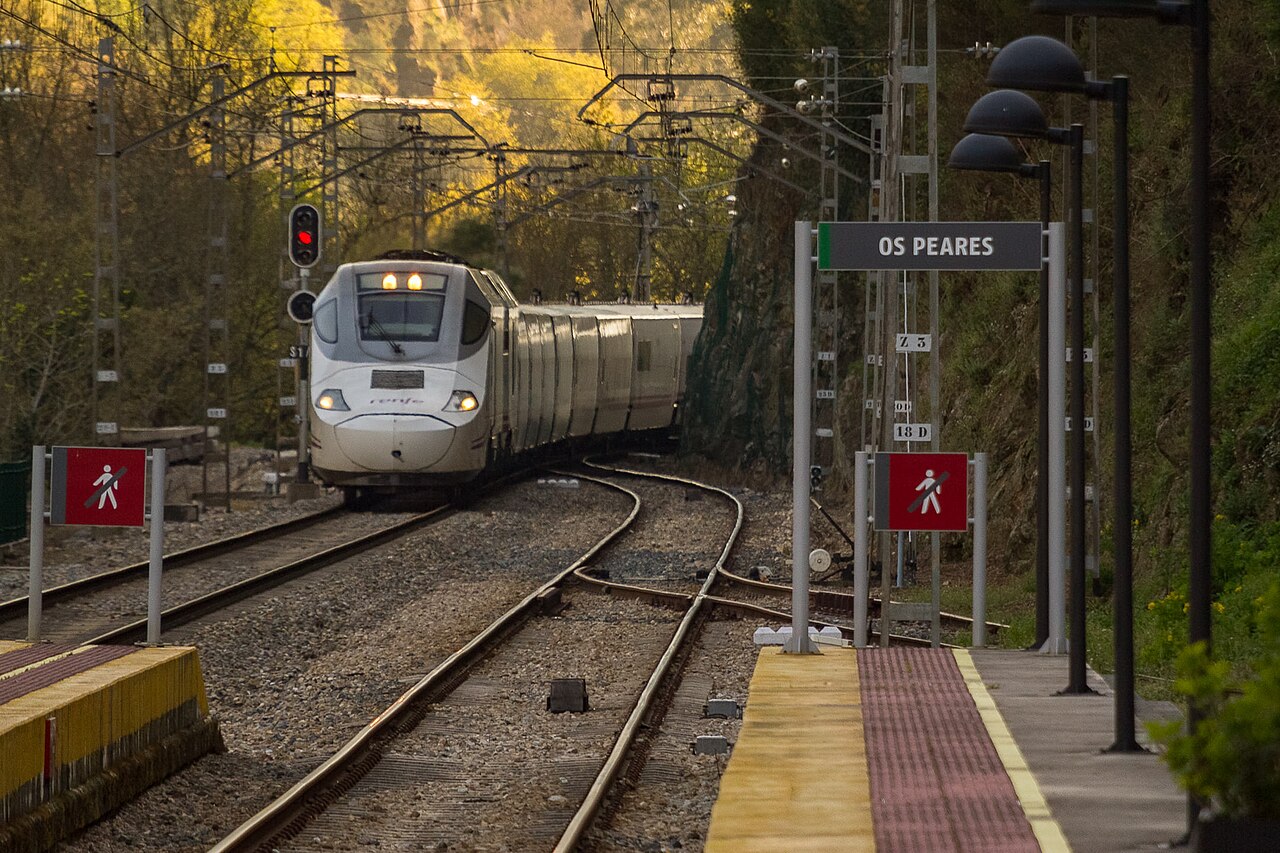
Leaps into Galicia through 30 tunnels, including the 8.6 km O Corno bore, then runs on down the Atlantic axis through Santiago de Compostela to the coast at A Coruña.
Stations
- 0 kmMadrid-Chamartín-Clara Campoamor +6
- 231 kmZamora +1
- 478 kmOurense-Empalme +1
- 566 kmSantiago de Compostela - Daniel Castelao +1
- 627 kmA Coruña +1
The stations this train called at in the operator’s timetable (ÖBB Scotty, the AVE 4345 on 12 October 2026), in order along the line as drawn here, with the distance along it. Other runs of the train may skip some of them, and the timetable can change. A +N after a station: N other routes on this map stop or end there, and the map draws it as a station where lines meet.
How this line was checked
- Line drawn from OpenStreetMap relation 6721028 — the same nodes OpenStreetMap holds for this railway, thinned to within 51 m of them
- Checked against OpenStreetMap: the whole line lies on real track, a median 16 m from it
- Checked against the running timetable via Renfe: our line passes within 211 m of every station AVLO calls at (the operator publishes no route geometry to compare)
- Wikipedia has an article for this line
- See for yourself: open this line on the map with OpenStreetMap's own railway drawn underneath it
Questions and answers
How long is the AVE?
The AVE runs 646 km from Madrid to A Coruña.
How long does the AVE take?
The fastest scheduled journey is 3 h 36 min for the 646 km. That is an average of 179 km/h end to end. The line's top service speed is 300 km/h.
Who runs the AVE?
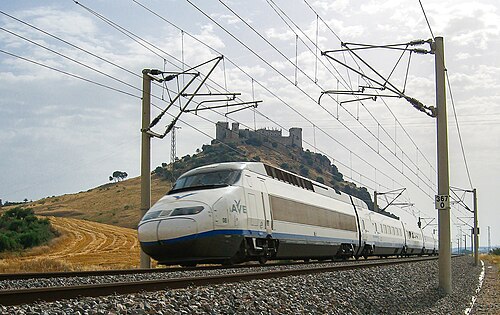
Renfe, with S-106 Avril, S-730 Alvia.
How old is the AVE?
The line has been in service since 2021. That is the year the atlas dates it from: for a modern brand running over an older railway, it is the railway's date, not the brand's.
More high-speed routes
- Eurostar
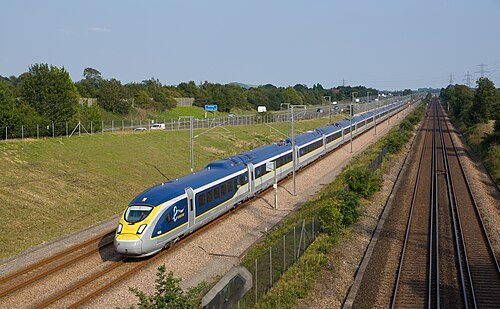
Drops 75 m below the sea through the 50.5 km Channel Tunnel, 37.9 km of it under the seabed, the longest undersea stretch of any rail tunnel.
Wikipedia ↗ - TGV inOui
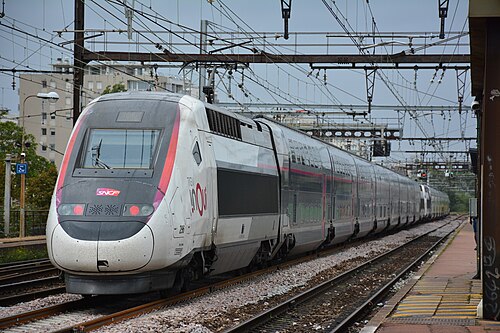
France’s original 1981 LGV forms the first leg; today the TGV holds 320 km/h nearly all the way to the Mediterranean.
Wikipedia ↗ - AVE
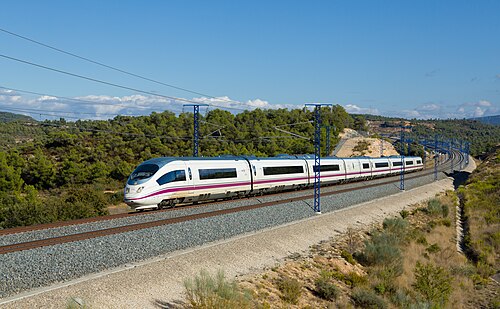
Scheduled at 300 km/h, this line flipped one of the world’s busiest air routes to rail.
Wikipedia ↗ - AVE
Spain’s first AVE, built for Expo ’92 in standard gauge, the line that reset Spanish railways.
Wikipedia ↗
More train routes in Spain.