
🇩🇪 Operator
Train routes operated by DB Fernverkehr
21 routes · high-speed 6 · classic 14 · scenic 1
DB Fernverkehr runs 21 of the routes in the World Train Map atlas, 7,848.4 km of railway across 2 countries. The longest is the ICE at 843 km; the fastest is the ICE, running up to 300 km/h; the oldest line it runs over here opened in 1847. 1 of its routes crosses an international border.
The company itself dates to 1999, filed on Wikidata as a railway undertaking. What this page says about the company comes from DB Fernverkehr's own Wikidata item, checked against the countries its routes here actually cross before any of it is used; everything about the railway is counted from this atlas. Official site ↗ · Wikipedia ↗ · Wikidata Q452140 ↗
Open the world railway map →- Routes here
- 21
- Total length
- 7,848.4 km
- Countries
- Germany, Switzerland
- Fastest
- ICE · 300 km/h
- Longest
- ICE · 843 km
- Oldest line here
- 1847
- Company founded
- 1999
- Type
- railway undertaking
High-speed (6)
- ICE
Crosses Germany from end to end, Berlin to the Swiss border, finishing down the Upper Rhine past Freiburg to Basel in about seven hours.
Wikipedia ↗ - ICE
Races the length of the North German Plain; the dead-straight Hanover–Berlin racetrack, partly laid on old border land, lets ICE 4 sets hold 250 km/h.
Wikipedia ↗ - ICE
Joins the political and banking capitals via Kassel and the Fulda gap, the Velaro D holding 250 km/h over the wooded ridges of northern Hesse.
Wikipedia ↗ - ICE
Runs the Hanover–Würzburg route, Germany’s first Neubaustrecke of 1991, boring through a chain of long tunnels under the hills of Hesse.
Wikipedia ↗ - ICE
Sprints down the 300 km/h Nuremberg–Ingolstadt high-speed line, one of Germany’s fastest, on gradients so steep that freight trains are banned.
Wikipedia ↗ - ICE
Opened in December 2022, the Wendlingen–Ulm line tunnels under the Swabian Jura and cut the Stuttgart–Ulm leg to just 42 minutes.
Wikipedia ↗
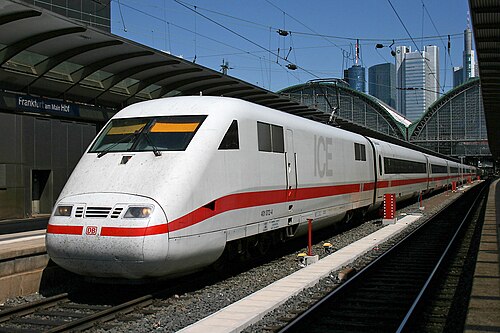
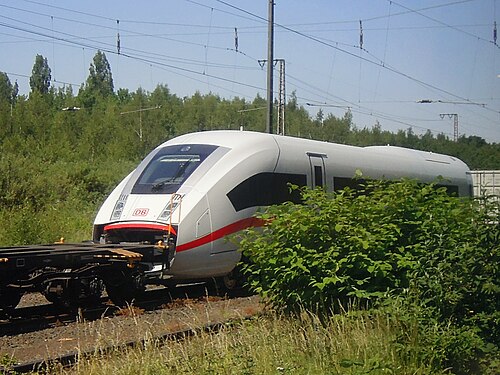
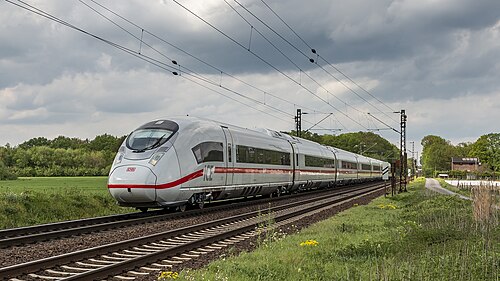
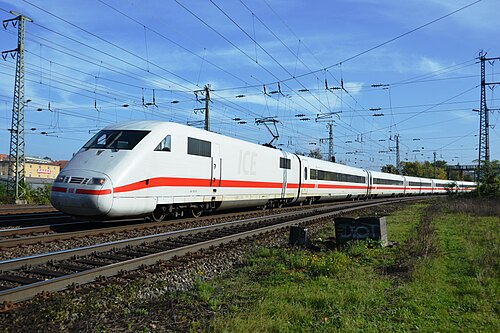
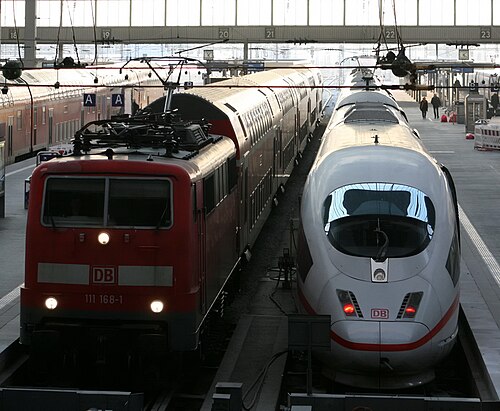
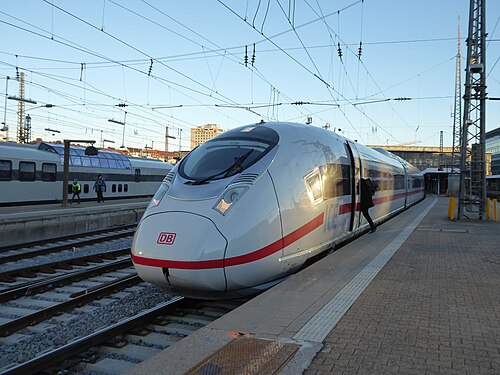
Classic (14)
- ICE Dortmund–Oberstdorf
The Ruhr to the Allgäu in one train: Dortmund, the Rhine gorge past the Lorelei, Mannheim and Ulm, then up the Iller valley to Oberstdorf under the Alps.
- IC Leipzig–Norddeich
Saxony to the North Sea ferry pier: Leipzig, Magdeburg and Hannover, then Bremen and the East Frisian flats to the quayside at Norddeich Mole.
- IC Gera–Düsseldorf
East Thuringia to the Rhine: Gera and Jena, Erfurt and Eisenach under the Wartburg, then Kassel, the Ruhr and Düsseldorf.
- ICE Frankfurt–Dresden
The Saxony ICE: Fulda’s wooded hills, Luther’s Eisenach and Erfurt, the 2015 high-speed line into Leipzig, then the Elbe plain to Dresden.
- IC Hamburg–Köln
Germany’s busiest conventional corridor: ports to Ruhr through Bremen, Münster and five more big cities — twice an hour, no high-speed line in sight.
Wikipedia ↗ - IC Leipzig–Warnemünde
Leipzig to the Baltic beach: Halle and Magdeburg, the Stendal cut-off and Schwerin, then Rostock and out to the pier at Warnemünde.
- IC Köln–Norddeich
DB’s seaside Intercity: down the Rhine-Ruhr, through Münster and the Emsland flats to the North Sea pier at Norddeich Mole.
- ICE Hamburg–Binz
The Rügen through train: out of Hamburg past Schwerin and Rostock to Stralsund, over the Rügendamm and on to the chalk coast at Binz.
- IC Karlsruhe–Nürnberg
The cross-country IC via the 1861 Remsbahn: Stuttgart, the Rems valley vineyards, then Aalen and Crailsheim’s hills to Nuremberg.
- Stralsund–Berlin railway
One of the oldest railways in Western Pomerania, built from 1863 by the Berlin-Stettin company and now the fast run down from Stralsund to Berlin.
Wikipedia ↗ - Palatine Ludwig Railway
The Pfälzische Ludwigsbahn of 1847, the Palatinate's main artery through Neustadt, Kaiserslautern and Homburg — and today part of the Paris–Frankfurt run.
Wikipedia ↗ - Magdeburg-Wittenberge railway
Double track and electrified across the Altmark, opened in 1849 by the Magdeburg-Wittenberge company and among the oldest railways in Germany.
Wikipedia ↗ - Stralsund–Rostock railway
Joins the two Hanseatic cities of the Baltic coast — single track, electrified, and rebuilt as German Unity transport project no. 1.
Wikipedia ↗ - Gäu Railway
The Stuttgart end of the Gäubahn, built by the Württemberg and Baden state railways and still the through road toward Zurich.
Wikipedia ↗
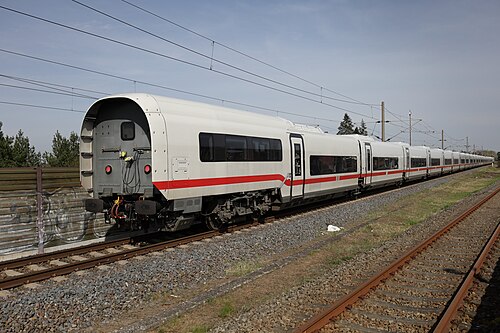
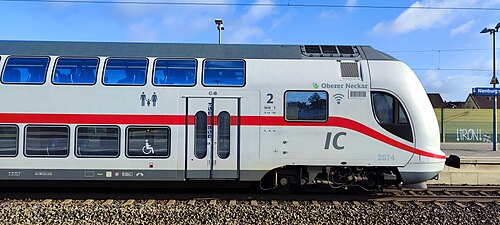
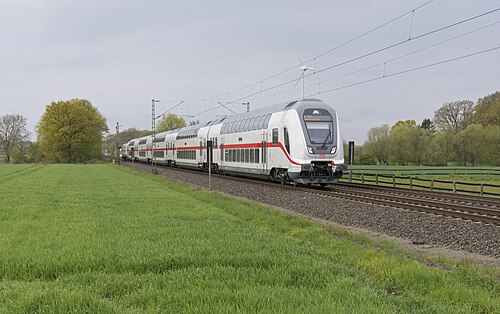
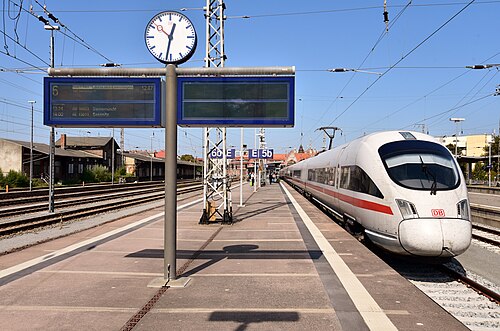
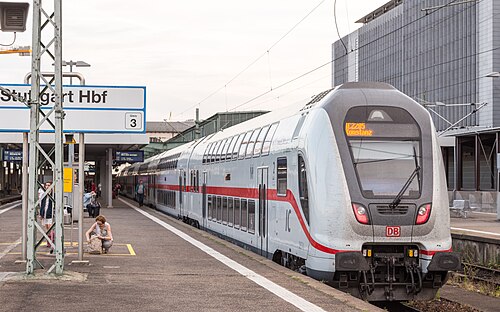
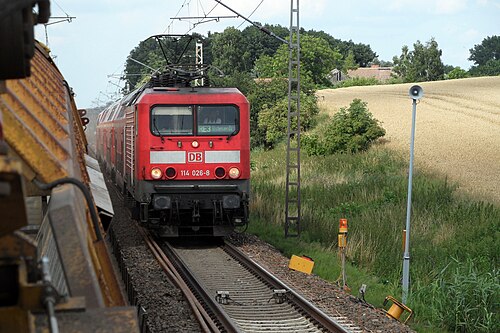
Scenic (1)
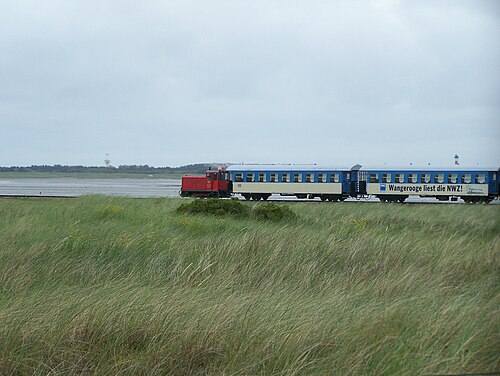
- Wangerooger Inselbahn
Deutsche Bahn’s only narrow gauge: the tide writes the timetable as diesels haul ferry passengers across the salt marsh from Westanleger pier to car-free Wangerooge village.
Wikipedia ↗
Photos via Wikimedia Commons — each route page credits the author & licence
How many train routes does DB Fernverkehr run?
21 of the routes in this atlas are DB Fernverkehr services, covering 7,848.4 km across 2 countries (Germany, Switzerland). That is what this atlas draws, not the operator's whole network — a national railway runs thousands of local services no map of notable journeys would list.
What is the fastest DB Fernverkehr train?
The ICE, Frankfurt to Munich, at up to 300 km/h. Its fastest scheduled run takes 3 h 15 min over 410 km.
Does DB Fernverkehr run night trains?
Not in this atlas. All 21 DB Fernverkehr routes listed here are daytime services.
When was DB Fernverkehr founded?
Wikidata records the company's inception as 1999, and files it as a railway undertaking. The oldest railway it runs over in this atlas opened in 1847 — the line and the company are rarely the same age, and this page dates both.
Countries DB Fernverkehr runs in
- 🇩🇪 Train routes in Germany 138 routes
- 🇨🇭 Train routes in Switzerland 71 routes
Other operators in Germany
- DB Regio 19 routes
- Deutsche Bahn 6 routes
- Arverio Bayern 3 routes
- Bayerische Regiobahn 3 routes
- erixx 3 routes
- Harzer Schmalspurbahnen 3 routes
- Mitteldeutsche Regiobahn 3 routes
- NordWestBahn 3 routes