
🇮🇹 Operator
Train routes operated by Trenitalia
41 routes · high-speed 12 · classic 24 · night train 1 · scenic 4
Trenitalia runs 41 of the routes in the World Train Map atlas, 11,746 km of railway across 1 country. The longest is the Frecciarossa Milan–Reggio Calabria at 1,213 km; the fastest is the Frecciarossa Milan–Reggio Calabria, running up to 300 km/h; the oldest line it runs over here opened in 1844.
The company itself dates to 2000, filed on Wikidata as a railway undertaking. What this page says about the company comes from Trenitalia's own Wikidata item, checked against the countries its routes here actually cross before any of it is used; everything about the railway is counted from this atlas. Official site ↗ · Wikipedia ↗ · Wikidata Q286650 ↗
Open the world railway map →- Routes here
- 41
- Total length
- 11,746 km
- Countries
- Italy
- Oldest line here
- 1844
- Company founded
- 2000
- Type
- railway undertaking
- Fastest
- Frecciarossa Milan–Reggio Calabria · 300 km/h
- Longest
- Frecciarossa Milan–Reggio Calabria · 1,213 km
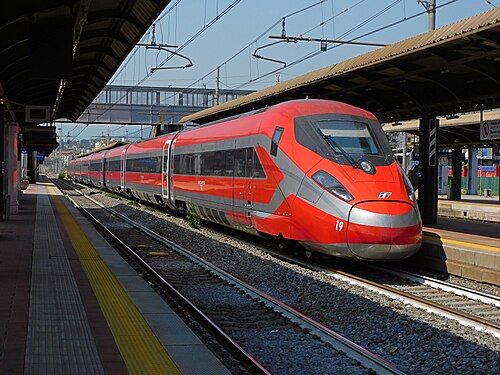
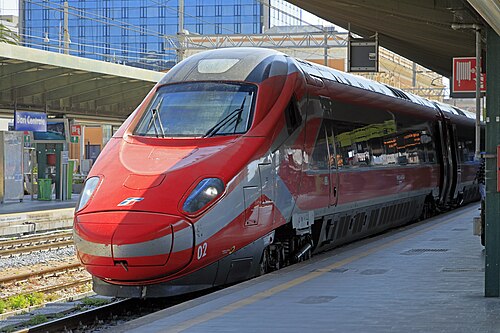
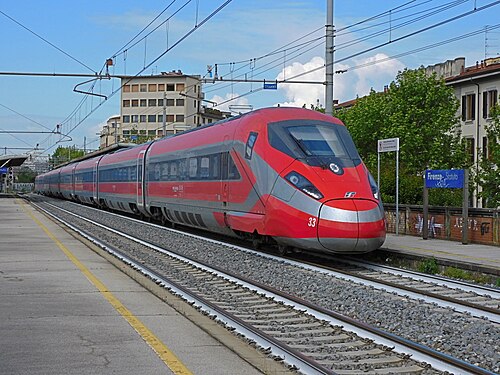
High-speed (12)
- Frecciarossa Milan–Reggio Calabria
The red arrow’s longest domestic run: the length of Italy from Milan down the Tyrrhenian coast to the Strait of Messina at Reggio Calabria.
Wikipedia ↗ - Frecciarossa Adriatica
Frecciarossas run the whole Adriatic seaboard: high-speed to Bologna, then the classic 1872 Adriatica within sight of the sea past Rimini, Ancona and Pescara to Bari.
Wikipedia (IT) ↗ - Frecciarossa
The 300 km/h spine of Italy. Milan–Bologna–Florence–Rome–Naples runs almost entirely on dedicated high-speed track finished in 2009.
Wikipedia ↗ - Frecciargento
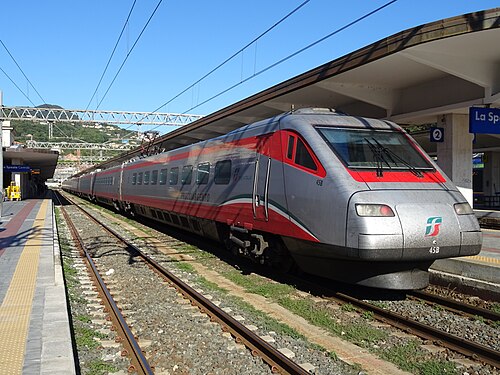
One of Italy’s longest Freccia runs: some 671 km down the Tyrrhenian coast, the tilting ETR 485 leaning through curves toward the Strait of Messina.
Wikipedia ↗ - Frecciargento
A tilting ETR 485 runs Rome to the heel of Italy’s boot via Foggia, Bari and Brindisi, reaching baroque Lecce in the Salento.
Wikipedia ↗ - Frecciarossa
Italy’s flagship corridor: since 2009 the airlines’ share has collapsed, and the ETR 1000 is engineered for 360 km/h.
Wikipedia ↗ - Frecciarossa
Frecciarossa 1000 sets cross from Rome over the Apennines and the Po plain via Florence and Bologna to reach Venice in under four hours.
Wikipedia ↗ - Frecciarossa
South of Caserta the Freccia climbs through the Apennines to Foggia, then races across the Tavoliere plain to the Adriatic port of Bari.
Wikipedia ↗ - Frecciarossa
A tilting ETR 600 Frecciarossa crosses the Po plain and Veneto from Milan to Trieste on the Adriatic, a run it took over in June 2023.
Wikipedia ↗ - Frecciarossa Milan–Venice
300 km/h out of Milan, then Verona, Vicenza and Padua: finishing with the causeway glide across the lagoon to Santa Lucia’s doorstep on the Grand Canal.
Wikipedia ↗ - Frecciarossa
Italy’s first true alta velocità line. Vesuvius on the horizon barely an hour after leaving Rome.
Wikipedia ↗ - Frecciarossa
A Frecciarossa 1000 hit 393.8 km/h on this Turin–Milan high-speed line in a 2016 test, an Italian rail speed record.
Wikipedia ↗
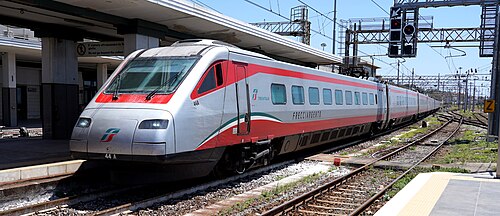
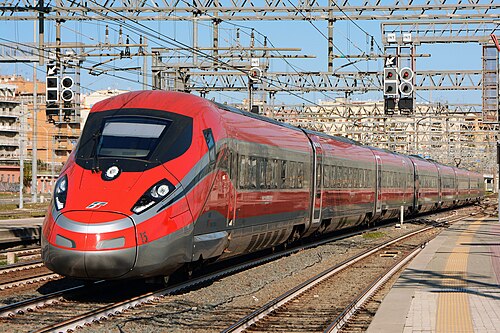
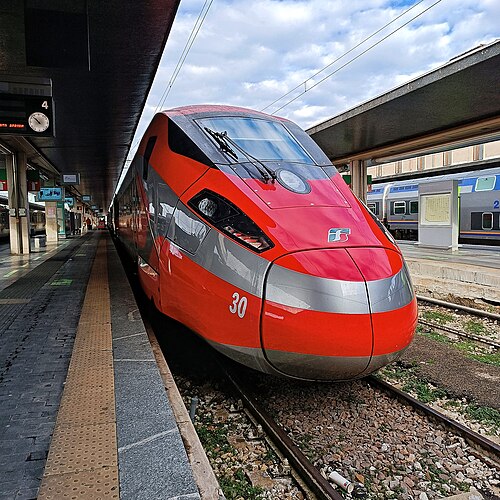
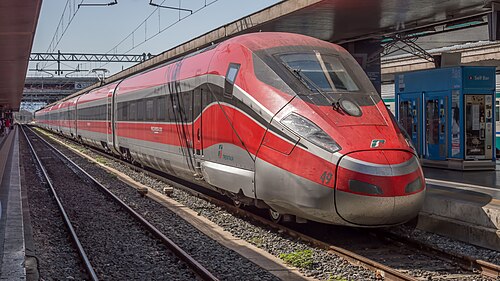
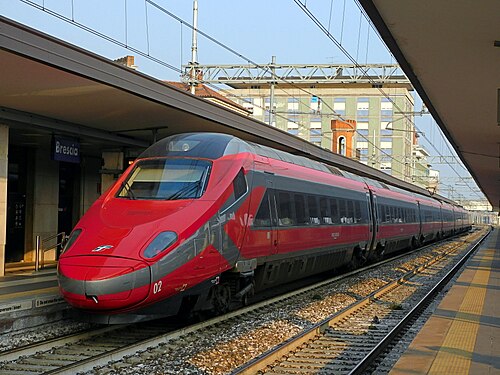
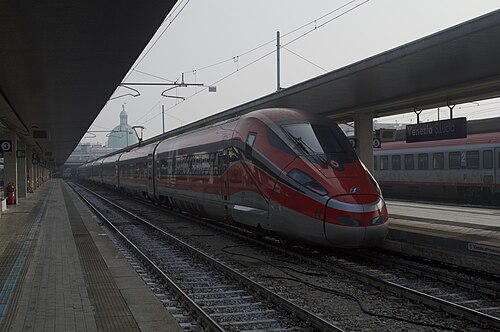
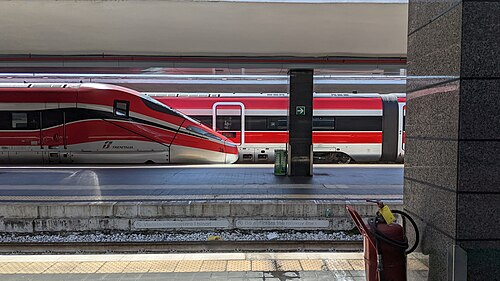
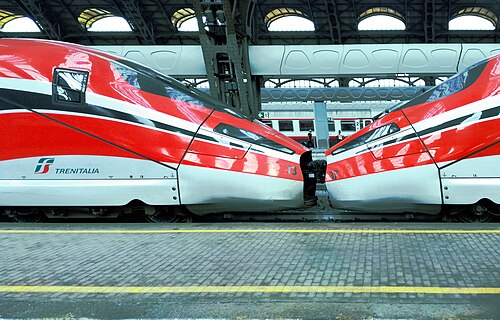
Classic (24)
- Intercity Tirreno
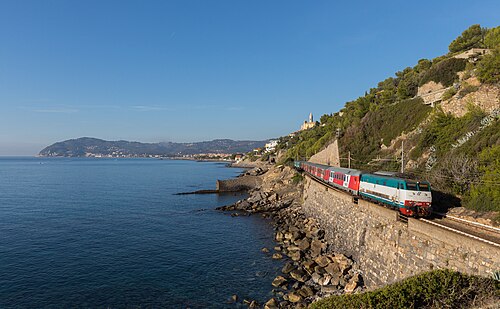
The Tyrrhenian artery the high-speed network bypasses: Maremma’s coast, Pisa, the marble Apuans and the whole Riviera di Levante into Genoa.
Wikipedia ↗ - Ionian Railway
Six hours down the instep and toe of Italy, from Taranto by Metaponto, Sibari and Crotone to the Strait of Messina; the sections were joined into one railway in 1875.
Wikipedia ↗ - Intercity Riviera
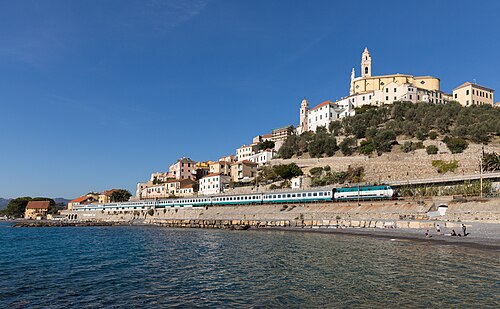
Down the Po plain to Genoa, then the full Italian Riviera westward: tunnel after tunnel between the mountains and the sea to San Remo and the French border at Ventimiglia.
- Cagliari–Sassari
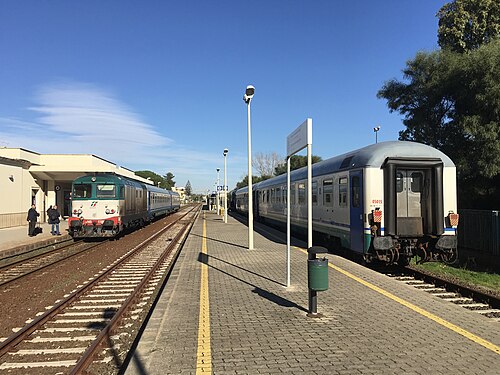
The Sardinian main line: three hours up the island’s spine through Oristano and the Campidano plain — the mainline Sardinia most visitors never know exists.
Wikipedia (IT) ↗ - Rome–Sulmona–Pescara railway
Rome to the Adriatic the hard way, over the Apennines by Tivoli, the drained Fucino basin at Avezzano and Sulmona, where the Transiberiana d’Italia branches into the Abruzzo highlands.
Wikipedia ↗ - Milan–Bologna classic line
The old road through Emilia by Lodi, Piacenza, Parma, Reggio and Modena, single track when it opened in 1861 and doubled by 1894; the Frecce take the high speed line beside it.
Wikipedia ↗ - Rome–Ancona railway
Crosses the Apennines sea to sea, from the Adriatic at Ancona through Foligno, Spoleto and Terni to Orte on the Rome main line.
Wikipedia ↗ - Palermo–Trapani railway
The long way round the west of Sicily, by Castelvetrano, Mazara and Marsala: the through line was finished on 5 June 1881, and since the short route by Milo closed in 2013 it is the only one.
Wikipedia ↗ - Turin–Genoa railway
Five years of tunnelling under the Apennines opened this line in December 1853, and the 3.3 km Giovi tunnel at its summit was then the longest in the world.
Wikipedia ↗ - Domodossola–Milan railway
The Simplon’s Italian approach, down the Toce and along the western shore of Lake Maggiore by Stresa and Arona; the rails reached Domodossola in 1888.
Wikipedia ↗ - Verona–Bologna railway
Thirty seven years to cross the Po plain: begun at Bologna in 1887, over the river at Ostiglia in 1911 and finished into Verona on 1 February 1924. Fifty two minutes now.
Wikipedia ↗ - Bari–Taranto railway
104 km across the Murge plateau from Bari through Gioia del Colle to Taranto, now covered end to end by Frecciarossa in a little over an hour.
Wikipedia ↗ - Livorno–Florence railway
The Ferrovia Leopolda of the 1840s, still carrying Tuscany's busiest regional run from Livorno and Pisa through Pontedera and Empoli into Florence.
Wikipedia ↗ - Civitanova Marche–Fabriano railway
Off the Adriatic at Civitanova and up the Chienti and Potenza valleys by Macerata and Matelica; begun in 1884 at the far end and joined up in 1888.
Wikipedia (IT) ↗ - Catania–Caltagirone railway
Valsavoia to Scordia opened in November 1889 and the whole climb to Caltagirone on 31 October 1892; the 1979 extension to Gela has been shut since a viaduct collapsed, reopening promised for 2026.
Wikipedia ↗ - Mantova–Monselice Line
Straight across the Po plain from Lombardy into the Veneto, Mantova to Monselice by Nogara, Legnago and Montagnana, on a secondary line whose first stretch opened with a special train on 16 May 1885.
- Udine–Trieste railway
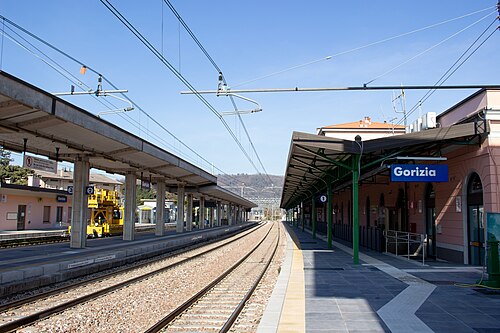
Friuli to the Adriatic through Gorizia and out along the Carso above Miramare; the last two sections opened three days apart in October 1860.
Wikipedia ↗ - Prato–Bologna Direttissima
The 1934 Direttissima under the Apennines: an 18.5 km base tunnel, then the second longest in the world, and 180 km/h where the old line over the pass managed 75.
Wikipedia ↗ - Avezzano–Roccasecca railway
Up the Liri from Roccasecca by Arce, Sora and Balsorano into the Fucino basin; eighteen years from the first section in 1884 to the last on 20 August 1902.
Wikipedia (IT) ↗ - Fossano–San Giuseppe di Cairo railway
The 1874 road to Savona ran the long way round through Bra; this double track shortcut by way of Mondovì and Ceva replaced it in 1933.
Wikipedia ↗ - Biella–Novara railway
Mussolini opened it on 18 May 1939 and no train ran for fourteen months, because the rolling stock was not ready; promised electric in 1925, it never was, and the state took it over in 1961.
Wikipedia ↗ - Chivasso–Casale Monferrato railway
A third class line under the Baccarini law of 1879, built to reach the Monferrato from the main line at Chivasso: the stretch from Castelrosso to Casale Popolo opened on 30 April 1887.
Wikipedia ↗ - Santhià–Biella railway
Inaugurated on 8 September 1856 with the public works minister aboard the special from Turin: 27 km down from the Biellese wool towns to the Turin–Milan main line at Santhià.
- Fidenza–Fornovo railway
A 1907 cut-off across the Emilian plain that lets Parma-bound freight and regional trains reach the Pontremolese line at Fornovo.
Wikipedia ↗

Night train (1)
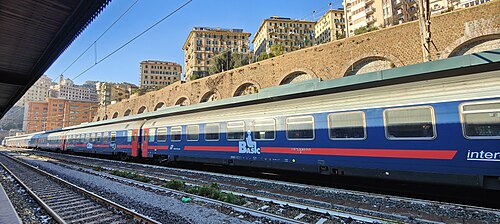
- Intercity Notte Rome–Palermo
Europe’s last train on a ship: the sleeper is split at Villa San Giovanni and floated across the Strait of Messina before breakfast.
Scenic (4)
- Ionian Coast Line
Sicily’s east coast end to end: out of Messina along the Ionian shore below Taormina, past Etna at Giarre and Acireale into Catania, then the salt flats and Augusta’s bay to Siracusa. Complete.
Wikipedia (IT) ↗ - Siena–Grosseto railway
Southern Tuscany at walking pace: 100 km through the Crete Senesi and the Maremma from Siena down to Grosseto, open since 1864.
Wikipedia ↗ - Valsugana Line
Out of Trento past the vineyards, along Lake Caldonazzo and down the gorge of the Brenta to the foot of Monte Grappa, twenty three stops in a bit over two hours on a line begun in 1896.
- Cinque Terre Express
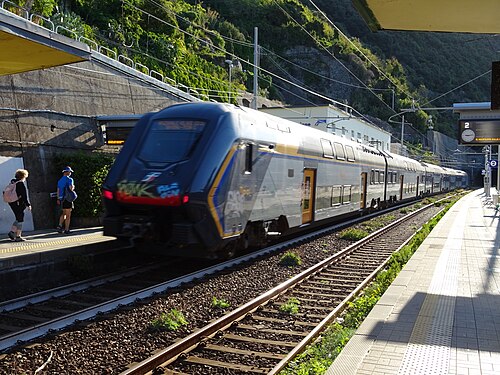
Village-hopping between tunnels where Liguria’s cliffs meet the sea. Monterosso, Vernazza, Corniglia, Manarola and Riomaggiore in half an hour.
Wikipedia (IT) ↗
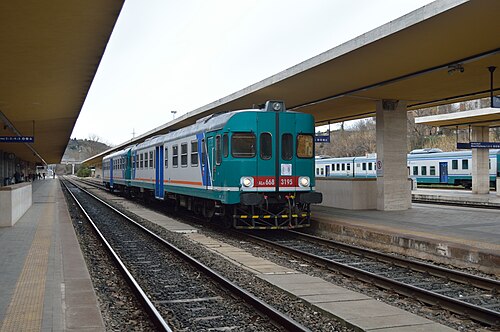
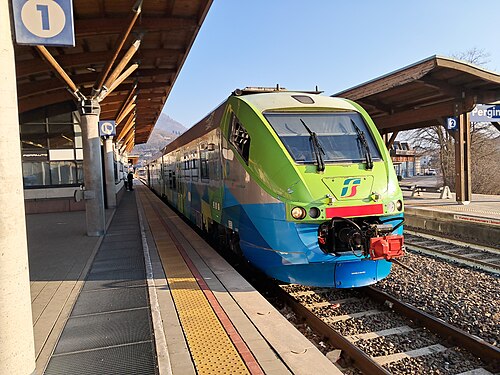
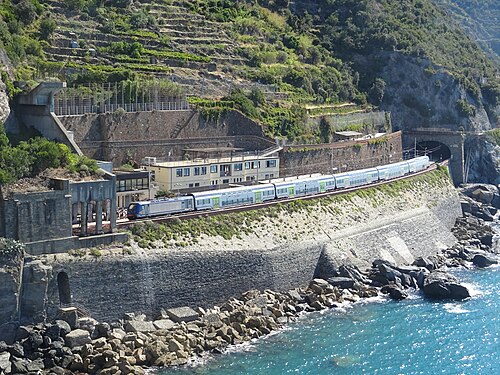
Photos via Wikimedia Commons — each route page credits the author & licence
How many train routes does Trenitalia run?
41 of the routes in this atlas are Trenitalia services, covering 11,746 km across 1 country (Italy). That is what this atlas draws, not the operator's whole network — a national railway runs thousands of local services no map of notable journeys would list.
What is the fastest Trenitalia train?
The Frecciarossa Milan–Reggio Calabria, Milan to Reggio Calabria, at up to 300 km/h. Its fastest scheduled run takes 9 h over 1,213 km.
Does Trenitalia run night trains?
Yes — 1 sleeper service in this atlas: Intercity Notte Rome–Palermo (Rome – Palermo).
When was Trenitalia founded?
Wikidata records the company's inception as 2000, and files it as a railway undertaking. The oldest railway it runs over in this atlas opened in 1844 — the line and the company are rarely the same age, and this page dates both.
Countries Trenitalia runs in
- 🇮🇹 Train routes in Italy 83 routes
Other operators in Italy
- Trenord 7 routes
- Fondazione FS 4 routes
- ARST 3 routes